From Student Data to
Strategic Intelligence
How Agentic AI in next-gen LMS software transforms raw numbers into a competitive advantage for your institution.
Your LMS is sitting on a goldmine of data. Every login, every quiz attempt, every video pause, every doubt asked — all of it is being recorded. But for most institutions, this data is never used. It sits in a database, generating reports that nobody reads.
The gap between data collection and strategic intelligence is where most EdTech institutions lose their competitive advantage. They have the raw material for extraordinary insights but lack the AI infrastructure to transform it into decisions.
Agentic AI in next-generation LMS platforms closes this gap entirely. It transforms raw student data into a continuous stream of strategic intelligence — at the individual student level, the cohort level, and the institutional level.
This article explains exactly how this transformation works, what data matters most, and what strategic decisions become possible when your LMS becomes an intelligence engine.
The 4 Categories of Student Data Your LMS Collects (But Probably Ignores)
Before we can talk about intelligence, we need to understand what data is actually available. Most institutions are surprised by how much they already have.
Behavioral Data
- Login frequency and session duration
- Video watch completion rates
- Quiz attempt patterns and timing
- Doubt-asking frequency and topics
Performance Data
- Test scores by topic and difficulty
- Accuracy trends over time
- Time-per-question analysis
- Improvement velocity per subject
Engagement Data
- Live class attendance rates
- Content interaction (likes, bookmarks)
- Peer discussion participation
- Resource download patterns
Operational Data
- Fee payment status and history
- Communication response rates
- Support ticket volume and topics
- Course enrollment and completion
The 4 Levels of Analytics Intelligence: Where Are You?
Not all analytics are equal. There are four distinct levels of intelligence, and most institutions are stuck at Level 1 or 2. Agentic AI unlocks Levels 3 and 4.
Level 1: Descriptive
What happened?"Student A scored 65% on the Physics test last Tuesday."
Basic reporting — available in all LMS platforms.
Level 2: Diagnostic
Why did it happen?"Student A scored 65% because they spent 70% of their time on 3 questions they got wrong, and their accuracy in Thermodynamics is 38%."
Advanced analytics — available in some modern LMS platforms.
Level 3: Predictive
What will happen?"Based on current trajectory, Student A has a 73% probability of scoring below 50% on the next test and a 45% dropout risk within 30 days."
AI-powered analytics — available in Agentic AI platforms.
Level 4: Prescriptive
What should we do?"Assign Student A a targeted Thermodynamics revision plan, schedule a mentor call, and send a motivational message. Do this automatically."
Autonomous action — the Agentic AI difference.
What Strategic Intelligence Looks Like in Practice
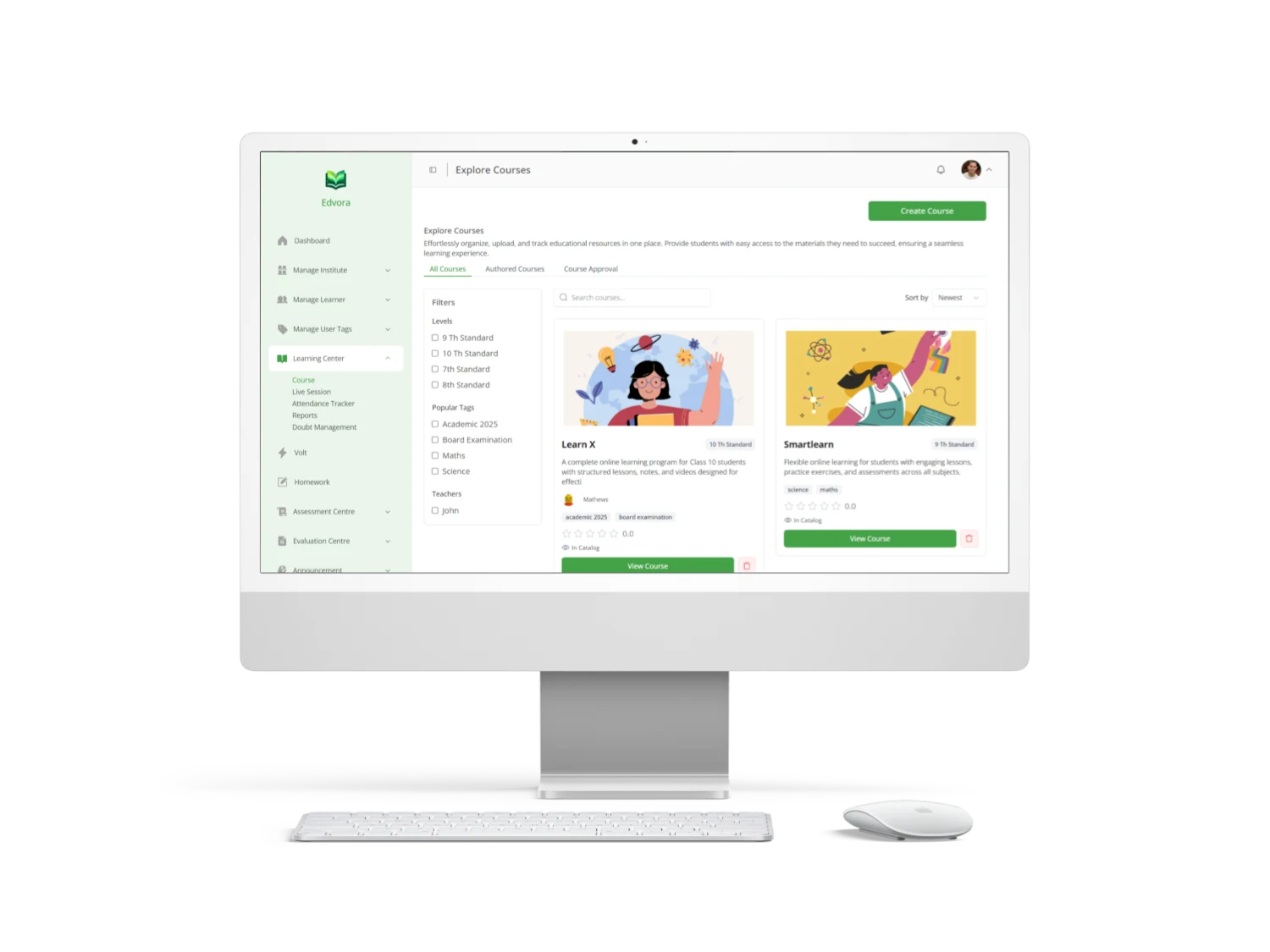
Vacademy's intelligence dashboard presents data not as numbers, but as decisions. Every metric is paired with a recommended action, making it impossible to look at the data and not know what to do next.
From Data to Action: The AI Feedback Loop
The most powerful aspect of Agentic AI is the feedback loop it creates. Student behavior generates data → AI analyzes data → AI takes action → action changes student behavior → new data is generated. This continuous loop means the system gets smarter and more effective over time.
Watch: AI generating personalized feedback reports that drive student action.
4 Strategic Decisions That Become Possible with AI Intelligence
When your LMS becomes an intelligence engine, entirely new categories of strategic decisions become possible — decisions that were previously impossible because the data wasn't available or analyzable.
Curriculum Optimization
Aggregate performance data across 5,000 students reveals that 68% struggle with the same 3 topics in Organic Chemistry. The AI flags this as a curriculum gap, not a student problem, and recommends restructuring the teaching sequence.
Faculty Effectiveness Analysis
Comparing student outcomes across faculty teaching the same subject reveals that one teacher's students consistently outperform others by 22%. The AI identifies the specific teaching patterns that drive this and recommends sharing them institute-wide.
Batch Composition Intelligence
Historical data shows that students who join in the first 2 weeks of a batch have 3x better completion rates than late joiners. The AI recommends closing batch enrollment earlier and creating a separate catch-up track for late joiners.
Revenue Forecasting
By analyzing engagement patterns, the AI predicts which students are likely to renew for the next course and which are at risk of churning. This enables proactive retention campaigns 30 days before renewal decisions.
Data Privacy and Security: The Non-Negotiables
Collecting and analyzing student data comes with significant responsibility. Vacademy is built with privacy-by-design principles, ensuring that the intelligence you gain never comes at the cost of student privacy.
Turn Your Data Into Your Biggest Asset
Stop letting valuable student data sit unused. See how Vacademy transforms it into strategic intelligence that drives better outcomes.
Frequently Asked Questions
What data does Vacademy collect about students?
Vacademy collects behavioral data (login patterns, content engagement), performance data (quiz scores, time-on-task), and operational data (attendance, fee status). All data collection is transparent and disclosed to students and parents.
Can I export the analytics data to my own BI tools?
Yes. Vacademy provides API access and CSV export functionality for all analytics data. You can connect it to tools like Google Data Studio, Tableau, or Power BI for custom reporting.
How does the AI know which interventions are most effective?
The AI tracks the outcome of every intervention it makes. Over time, it learns which types of messages, content assignments, and alerts produce the best response from different student profiles, continuously improving its effectiveness.
Can I see analytics for individual faculty members?
Yes. Vacademy provides faculty-level analytics showing student outcomes by teacher, content quality metrics, and engagement rates. This data can be used for performance reviews and professional development.
How is student data protected from unauthorized access?
Vacademy uses AES-256 encryption for data at rest, TLS 1.3 for data in transit, and role-based access controls to ensure that only authorized users can access specific data. Regular security audits are conducted.
Can parents access their child's analytics data?
Yes. Parents have access to a simplified dashboard showing their child's attendance, test scores, and overall progress. They receive automated weekly reports without any manual effort from the institute.
Ready to experience the
Future of Learning?
Join thousands of educators and institutions who have switched to Vacademy for a seamless, automated, and intelligent teaching experience.